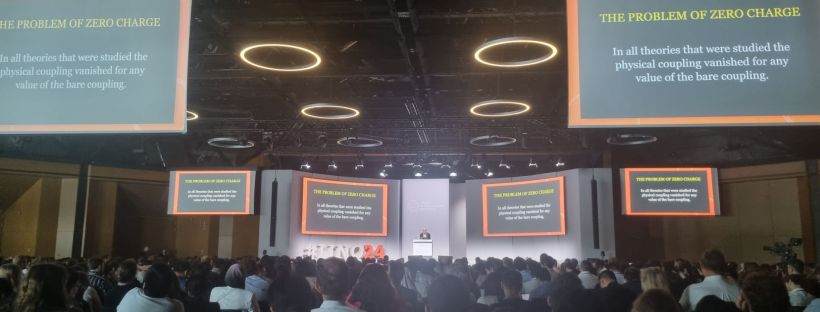
“There difference between the macro and micro has nothing to do with quantum and the classical.” – Anton Zeilinger
Attosecond Pulses of Light for the Study of Electron Dynamics by Anne L’Huillier. The opening session was by Anne L’Huillier, the one of three winners of the Nobel Prize in Physics 2023, for “for experimental methods that generate attosecond pulses of light for the study of electron dynamics in matter”. Her talk detailed the journey to the development of attosecond pulses, from initial ideation, to the necessary tools for its detection. The science is really beautiful and worth a full listen here. I recall learning about attosecond physics many years ago during my masters at University of Manchester. It was mesmerising then and it was very enjoyable to learn it directly today from one of the founding physicists of the field.
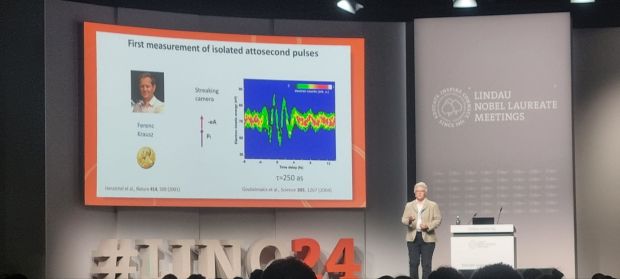
I think it is a really rewarding exercise to carefully work through the process of HHG and trace the logic to the eventual generation of Attosecond pulses. Anne covered this really nicely.
A Voyage through Quantum Wonderland by Anton Zeilinger. The talk focussed on the journey to developing experiments to test fundamental questions in quantum mechanics. A bit closer to home for me, even though I was very familiar with the works, but Anton’s presentation was fantastic, and very engaging. He also put in some thought-provoking comments such as:
“There is no limit to superposition“
He was also very frank about how he times have changed now for researchers, from when he carried out his initial work:
“The GHZ experiment was on my plans for 10 years, impossible to do this now…“
There was also a very interesting ideas that he further elaborated in a later Open Exchange. He in passing mentioned that Clauser actually didn’t believe that entanglement occurred on spacetime and that he never talked about nonlocality! Although, never mentioned by Anton, what I understood by this is that maybe we should think about Hilbert Space as objectively in existence, albeit intangible. Then the natural consequence of this would be think about ways to access and create structures in Hilbert Space.
Materials of the Future by Sir Konstantin Novoselov. This was a very tech focussed talk and showed some really amazing applications being explored for graphene. What really stood out was this idea of active smart membranes. This he argued was a bottom up approach and to build materials that have in-built capability to respond to external stimuli. A really beautiful example he gave was of how a material repaired a hole by itself!
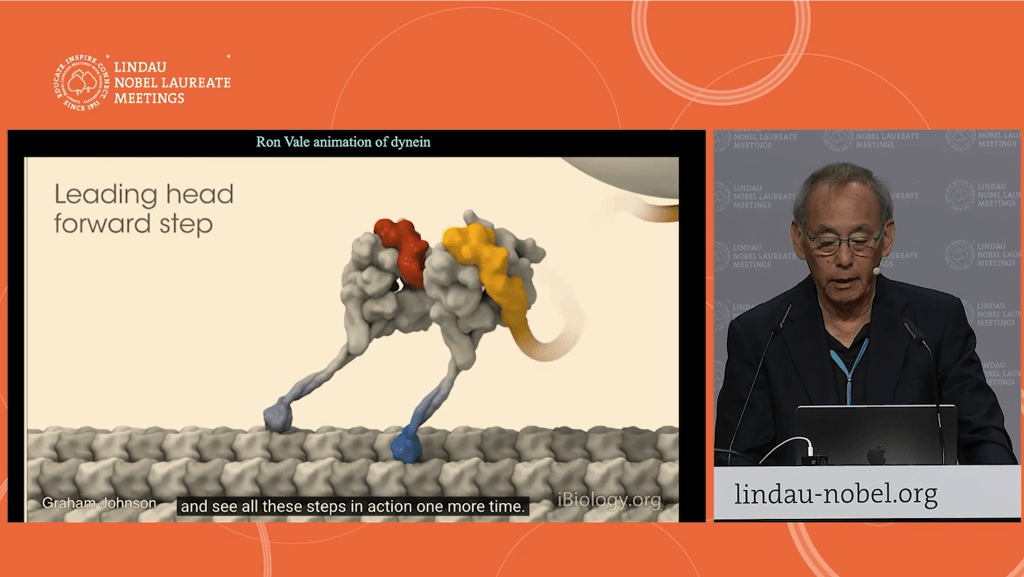
These set of lectures were followed by some agora talks. The most notable one I attended was by Steven Chu and Stefan Hell. Stefan discussed the limits of the Rayleigh limit and that this isn’t really a limit anymore and that we need to rethink this limit. He presented his work in using doughnut beams to beat the Rayleigh limit. This was very exciting, because this is the research I was doing with Phil Jones during my undergraduate degree. He was followed by a presentation by Stefan Chu with his research in looking biological motor/machines and using fluctuation dissipation theorems as a means to carry out further analysis. Another topic close to my heart.
Both presentation were beautifully clear and concise.
Day two was extremely busy. There were so many talks it felt like with constant talking and listening there were no breaks. Even during breaktime and lunch, we were conversing! This was going to be a recurring theme through this meeting. The evening was wrapped up with a International Evening hosted and sponsored by Texas A&M University. With traditional dancing and singing, music and food! Delicious. Dinner was specially unique as I got to sit next to Donna Strickland, the noble prize winner 2018. We talk very casually about some interesting examples from her life as an academic, balancing family and work.
I think that day went like a blur, and being wrapped up into the progression of hourly agenda and the conversations in full swing, being amongst the Nobel Prize winners was becoming a normality not a novelty already.
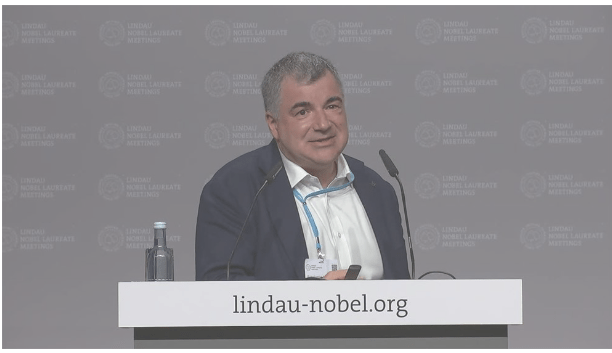
Sir Konstantin S. Novoselov
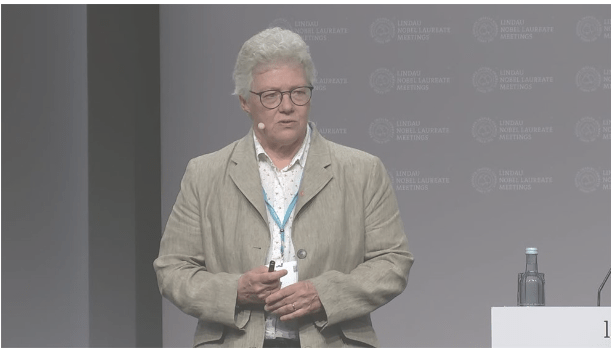
Anne L’Huillier
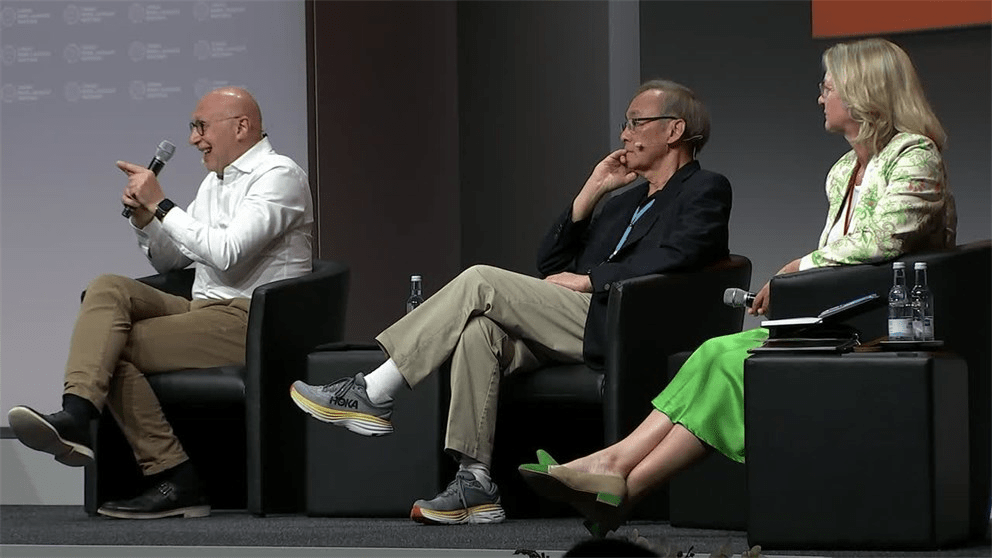
Steven Chu, Stefan W. Hell
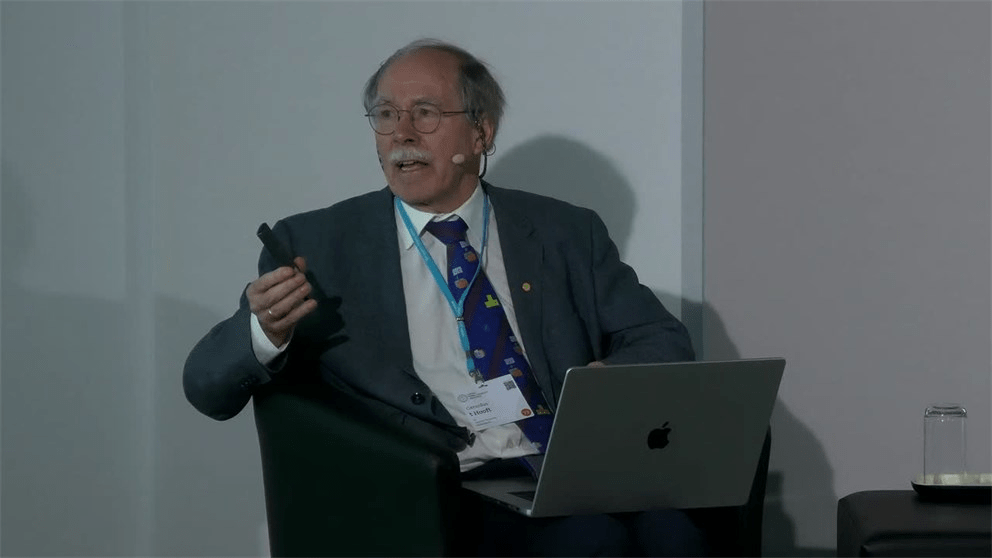
Gerardus ‘t Hooft
 Muddassar A Rashid